
If you want to improve your smile, you may be considering Invisalign or veneers. Both treatments can dramatically enhance the appearance of your teeth, but they work in very different ways. Understanding the benefits of each option can help you determine which treatment best fits your goals, lifestyle, and oral health needs.
How Invisalign Works
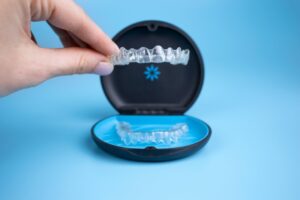
Invisalign uses a series of custom-made clear aligners to gradually move teeth into better positions. The aligners are removable and nearly invisible, making them a popular alternative to traditional braces.
Invisalign focuses primarily on correcting orthodontic issues such as:
- Crooked teeth.
- Crowding.
- Gaps between teeth.
- Mild bite problems.
Because Invisalign physically moves the teeth, it improves both appearance and function.
Benefits of Invisalign
One major benefit of Invisalign is that it addresses the underlying alignment problem rather than simply covering it up. Straighter teeth are often easier to clean, which may reduce the risk of problems like gum disease and tooth decay.
Other advantages include:
- Clear, discreet appearance.
- Removable aligners for eating and brushing.
- No metal brackets or wires.
- Improved bite alignment and function.
Many patients also appreciate that Invisalign can provide long-term orthodontic correction while maintaining a natural appearance during treatment.
However, Invisalign treatment usually takes several months or longer, depending on the complexity of the case.
How Veneers Work
Veneers are thin shells, typically made from porcelain, that are bonded to the front surfaces of teeth. Unlike Invisalign, veneers do not move teeth. Instead, they improve the appearance of teeth by covering cosmetic imperfections.
Veneers are commonly used to correct:
- Discoloration.
- Chips or cracks.
- Minor gaps.
- Uneven or misshapen teeth.
They can often create dramatic cosmetic changes in a relatively short amount of time.
Benefits of Veneers
One of the biggest benefits of veneers is their ability to quickly transform a smile. Patients can often achieve a whiter, more symmetrical appearance in just a few dental visits.
Porcelain veneers are also highly stain-resistant and can provide long-lasting cosmetic improvements with proper care.
For patients with minor cosmetic concerns who do not need major orthodontic correction, veneers may offer a faster solution than Invisalign.
Which Option is Right for You?
The best choice depends on your specific goals. If you want to straighten teeth and improve bite alignment, Invisalign may be the better option. If your primary concern is cosmetic appearance, veneers may provide faster results.
In some cases, dentists may even recommend combining orthodontic treatment with veneers for optimal results.
It’s also important to remember that veneers typically require removing a small amount of enamel, while Invisalign is generally less invasive.
Both Invisalign and veneers offer unique benefits for improving your smile. Invisalign focuses on correcting alignment and function, while veneers provide fast cosmetic enhancement for visible imperfections.
A consultation with your dentist can help determine which treatment best matches your smile goals, oral health, and lifestyle.
About the Author
Dr. Terri Alani, the “Texas Tooth Lady,” has been practicing dentistry for more than 30 years and earned her dental degree from the University of Texas at Houston. With a focus on cosmetic dentistry, she’s more than able to upgrade your smile through veneers or Invisalign. Dr. Alani is also a member of the Greater Houston Dental Society, the Texas Dental Association, and the American Dental Association. If you’re interested in a better-looking grin, book online or call her Houston office at (713) 621-5141.